


Touchless kitchen fixtures can make everyday tasks feel smoother without changing the character of your kitchen. Before choosing a sensor faucet, consider whether its activation style suits your routine, whether its dimensions work with your sink, and whether its design fits the room.
The right choice balances convenience with considered design. A sensor detects movement near the faucet and activates water, offering a hands-free option for tasks such as rinsing produce or washing up. To judge how comfortably it will work, compare the sensor’s position and operating details with the faucet’s dimensions, your sink proportions, and the controls provided.
This guide explains the basic operating principle and helps you compare features with your household in mind. We’ll look at sink fit, workflow, finishes, and the difference between useful functions and added technology. With a clear set of priorities, you can browse sensor faucet options and choose one that feels like a natural part of a well-designed kitchen.
Key Takeaways
- Understand how touchless kitchen fixtures use sensors to detect a nearby hand and activate water during everyday kitchen tasks.
- Compare touchless and manual faucets by activation, interaction, upkeep, and design to find the approach that suits your household.
- Choose a faucet by starting with your routine, then assessing sink fit, controls, care, and style.
- Use the faucet’s stated dimensions and specifications to judge how it may work with your sink setup.
- Explore sensor faucet options at SellHots with a clearer sense of the features and design details that matter to you.
What Are Touchless Kitchen Fixtures, and How Do They Fit into a Modern Kitchen?
Touchless kitchen fixtures are kitchen faucets that use a sensor to activate water when a hand enters its detection area. Instead of relying only on a manual handle to start the flow, a sensor-operated faucet offers a hands-free way to access water at the sink. The Automatic faucet reference explains the broader category and its basic operating principle.
In a modern kitchen, this function is part of a larger design decision: how the sink area supports daily routines and fits the room. A hands-free faucet may suit a household that often moves between food preparation and cleanup, but it isn’t essential for every kitchen. Think about who uses the sink, what kinds of tasks happen there, and whether sensor activation feels intuitive. The faucet should also work with the basin and surrounding fixtures.
How does a touchless kitchen faucet differ from a manual faucet?
A manual faucet starts and stops when someone operates its handle. A sensor faucet responds when a hand moves into the sensor’s range, reducing the need to touch the handle to activate water. The specific controls and operating sequence vary by model, so “touchless” doesn’t describe every detail of how a faucet behaves.
This difference can be useful when your hands are occupied or messy, such as while rinsing ingredients or moving between food preparation and washing up. A manual handle may feel more familiar if you prefer direct, physical control. Neither style is automatically better. Consider which interaction will feel comfortable to the people who share the kitchen.
Where can touchless fixtures make sense in a kitchen?
Think about the sink as part of a sequence of tasks rather than an isolated fixture. During preparation, you might reach for water while handling produce. During cleanup, you may rinse a dish or wash your hands between jobs. In a shared kitchen, different people may approach the faucet throughout the day, each with their own habits.
Use these routines to decide whether touchless operation would feel natural or add an unnecessary step. Consider who uses the sink, what typically happens around it, and whether there’s enough space for the faucet to work comfortably with the basin and nearby surfaces. The faucet’s placement and form should feel balanced with the sink area, not chosen for its technology alone.
For a considered choice, weigh everyday function alongside appearance. A sensor faucet can bring a contemporary detail to the kitchen, while its finish and overall shape should still feel at home with the sink and surrounding design. Starting with your household routine helps narrow the touchless kitchen fixtures worth comparing.
How Do Touchless Kitchen Fixtures Work During Everyday Use?
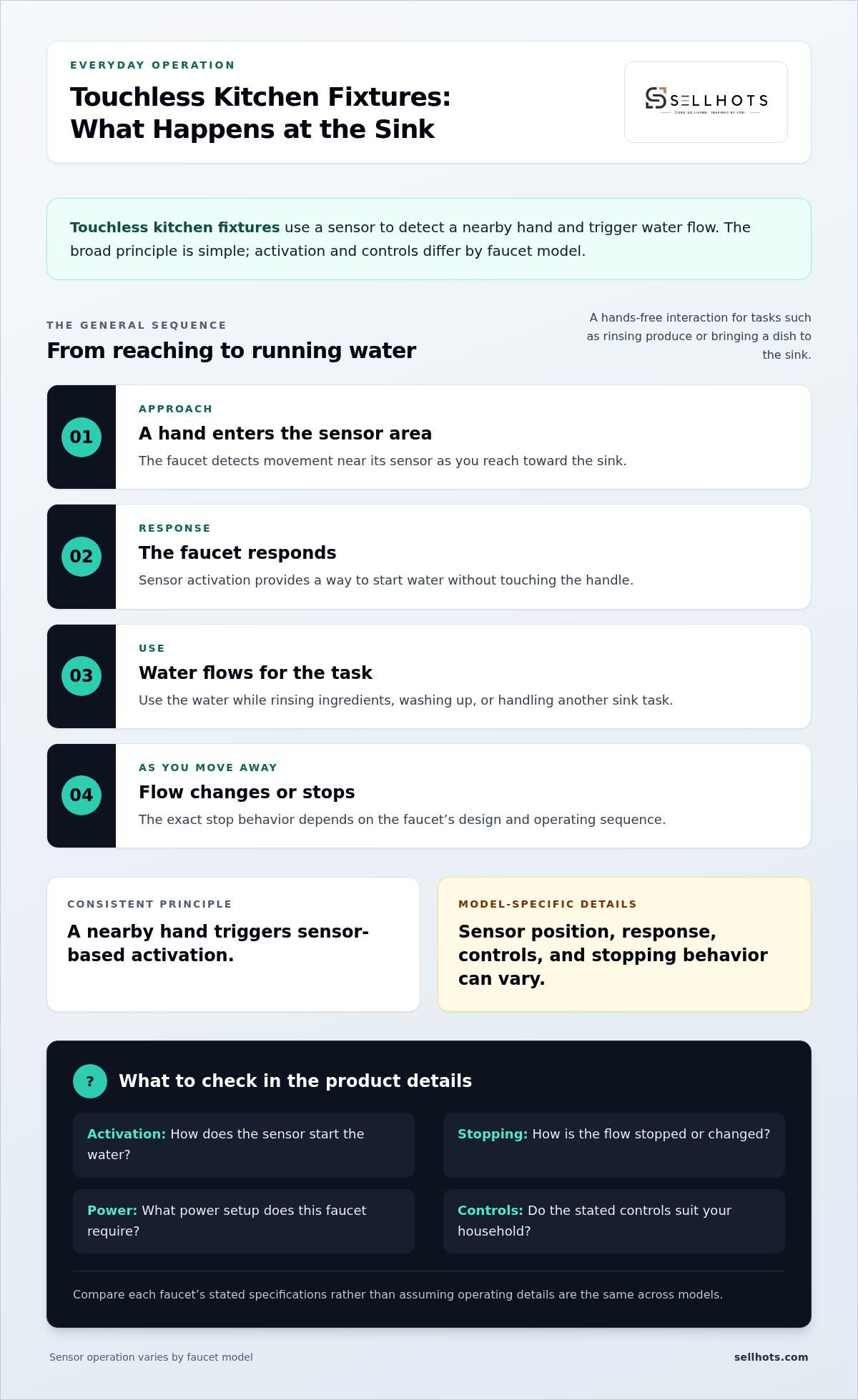
Touchless kitchen fixtures use a sensor to detect a nearby hand and trigger water flow, creating a different interaction from turning a conventional faucet handle. The principle is simple, but details such as how activation starts and stops depend on the individual faucet’s design.
What happens when a hand enters the sensor area?
In general, the sequence is straightforward: a hand approaches the sensor, the faucet responds, water flows, and the flow changes or stops when the hand moves away. For example, you might reach toward the faucet while holding a rinsed vegetable or bringing a dish to the sink. The sensor offers a hands-free way to start the water, but response and operation aren’t identical across all models.
The sensor principle is broadly consistent, while the activation and control experience is specific to each faucet model. Sensor placement, response behavior, and how water is stopped can vary. “Touchless” describes the general method of activation, not a universal operating sequence. Review a faucet’s product details to understand how its sensor works in practice.
If the interaction feels unfamiliar, treat that as part of the decision. You may appreciate reducing handle contact during messy tasks, or you may prefer the familiarity of manual controls. The goal is to understand how the faucet operates and decide whether that interaction feels comfortable for your routine.
What should shoppers know about power and controls?
Power and controls are product details to compare, not features to assume across the category. Individual faucets may differ in how they’re powered and in the controls they provide. Read each product’s stated specifications to understand what’s required and how water flow is managed. Don’t rely on assumptions based on another faucet’s setup.
Before choosing, consider what you’ll want to know during ordinary use: how activation works, how to stop the flow, and whether the listed controls suit your household. These questions turn a broad feature label into a practical picture of the experience. For another perspective on evaluating touchless models, Bob Vila’s faucet options are tested and reviewed.
As you compare touchless kitchen fixtures, give equal attention to the stated operating details and the design. A sensor faucet should make sense for your habits rather than ask you to adapt to features you don’t need. Browse sensor faucet options with your everyday sink routine in mind.
Touchless Kitchen Fixtures vs. Manual Faucets: What Should You Compare?
Touchless kitchen fixtures and manual faucets offer different ways to interact with the sink, and neither is automatically easier for every household. Compare how each fits your routine, sink layout, care preferences, and desired look before choosing.
| Consideration | Touchless faucet | Manual faucet |
|---|---|---|
| Activation | A sensor responds to a hand near its detection area; exact behavior varies by model. | A handle starts, adjusts, or stops water flow. |
| Interaction | Can suit hands-busy moments, though sensor activation may feel unfamiliar at first. | Offers direct, familiar handle control. |
| Upkeep | Follow the product’s care guidance for its finish and sensor components. | Follow the product’s care guidance for its finish and handle. |
| Design | Sensor placement and faucet form influence the look and fit at the sink. | Handle style and faucet form shape the look and available sink arrangement. |
Use the comparison as a starting point, then explore SellHots sensor faucets with your kitchen’s needs in mind.
When might a touchless faucet suit your kitchen routine?
Consider how often your sink is part of food preparation, cleanup, or shared household routines. If you regularly approach it with occupied or messy hands, activating water without first operating a handle may feel convenient. That doesn’t mean every task becomes simpler: you may still prefer a handle for certain interactions, and sensor response depends on the chosen fixture.
Think about how people move around the sink, too. In a busy shared space, hands-free activation may appeal to multiple users. In a compact or unusually arranged sink area, the faucet’s position and sensor location can affect how naturally it fits into daily use. Match the interaction to your habits rather than assuming a sensor is an upgrade for everyone.
When might a manual faucet feel like the better fit?
A manual faucet may suit someone who values familiar, direct control or prefers adjusting water through a handle. It can also feel more natural if sensor activation doesn’t align with how your household uses the sink. Consider the handle’s placement alongside the basin and surrounding space, as well as how the faucet’s form complements your kitchen.
Ultimately, weigh routine, sink layout, interaction, and design together. The right choice is the fixture that works comfortably in your kitchen, not the one with the most advanced-sounding feature.
How to Choose Touchless Kitchen Fixtures for Your Sink and Workflow
Touchless kitchen fixtures are easiest to assess when you start with how your sink is used, then check fit, operation, care, and appearance. This order keeps your decision grounded in your kitchen rather than a feature list alone.
- Start with your routine. Think through the tasks that happen at the sink, from food preparation to cleanup, and whether sensor activation would feel natural during them. Consider who uses the kitchen and whether everyone is comfortable with hands-free controls.
- Check the sink fit. Note the sink configuration, faucet mounting area, and available clearance around the basin and countertop. Compare these details with the product’s stated dimensions and specifications. Check the faucet’s height and reach against the basin to assess how its shape and placement may work in your setup.
- Compare controls. Review each fixture’s product information to understand how water is activated and managed. Controls can differ between models, so focus on the described operation and decide whether it matches your preferred interaction.
- Review care guidance. Look at the upkeep instructions for the faucet’s finish and components. Choose an option whose care guidance feels manageable for your household, and follow the use and care instructions supplied with the fixture.
- Consider design as part of the fit. Assess the faucet’s form and finish alongside the sink, countertop, and surrounding materials. A cohesive choice should feel intentional in the room as well as practical at the basin.
A confident faucet choice brings routine, sink fit, controls, care, and design into balance. Let the product’s own dimensions and stated specifications guide your comparison, rather than relying on assumptions based on another model.
Which sink and countertop details should you consider?
Look closely at the sink configuration, where a faucet can be mounted, and the clearance around that area. These details shape how a fixture may sit and function. Compare them with the exact product information for each option you’re considering. Check the faucet’s dimensions against the mounting area and basin, and use its stated requirements as part of your planning rather than assuming every faucet suits every sink.
How do controls, care, and design shape the choice?
Product listings can help you compare activation controls and care guidance without treating features as universal. Then consider whether the fixture’s finish and form create visual balance with your kitchen. A sensor faucet should support your routine and feel at home in the space. Explore SellHots sensor faucet options as you refine your shortlist.
Discover Touchless Kitchen Fixtures That Bring Ease and Design Together
Touchless kitchen fixtures are most satisfying when their everyday operation and visual presence feel right for the kitchen. Begin with the routine at your sink, then consider whether the fixture suits the sink setup, offers controls that feel intuitive, and complements the room’s overall style. No single feature needs to carry the decision on its own.
Choosing a sensor faucet is a design decision as much as a practical one. The faucet sits within a working space, but it also contributes to the kitchen’s visual rhythm. Its form should feel at ease beside the sink and countertop, while its operation should make sense for the people who use it. The aim isn’t to add technology for its own sake. It’s to choose a fixture that belongs in your daily routine and your home.
What makes a touchless faucet feel considered rather than purely technical?
A considered fixture supports the way you use the sink without competing with the rest of the room. Think about the transitions that happen throughout an ordinary day: preparing food, rinsing dishes, and sharing the kitchen with others. Then picture the faucet in that setting. Does its operation seem natural for those tasks? Does its shape feel visually balanced with the sink area? These questions connect function with the atmosphere you want to create.
Visual harmony comes from the whole arrangement, not one feature in isolation. The sink, countertop, and faucet all contribute to a cohesive kitchen. Review the product details for each option rather than assuming a particular finish, material, or control is standard across sensor faucets. This comparison keeps your choice grounded in what the individual fixture offers.
What is the simplest next step toward choosing a fixture?
Start browsing with your sink configuration and household routine in mind. As you compare sensor faucet options at SellHots, look at the specifications and care information shown for each product. Consider how the stated dimensions relate to your sink setup, and whether the described controls and care guidance suit your preferences. A steady comparison can make the selection feel clear, rather than turning it into a search for the longest feature list.
The best match is one that feels suited to both the space and the people who use it. Keep your priorities close as you explore, and let the details guide you toward a faucet that brings function and design into balance. Discover sensor faucets at SellHots.
Choose a Faucet That Feels Right at Home
Touchless kitchen fixtures are a considered choice when sensor operation suits your routine, fits your sink, and feels at ease with your kitchen’s design. Compare how each faucet activates, its stated dimensions and specifications, and its care guidance before deciding. The right balance is personal: a hands-free option can suit some households, while others may prefer the direct familiarity of a manual faucet.
Let practical fit and visual harmony guide you, rather than choosing features for their own sake. SellHots offers sensor faucets with an emphasis on quality, design, and a seamless shopping experience, making it a natural place to continue exploring your options.
Discover sensor faucets at SellHots and take the next step toward a fixture that feels considered in both form and everyday use. With your routine and sink setup in mind, you can browse with confidence and choose a style that belongs in your kitchen.
Frequently Asked Questions
What are touchless kitchen fixtures?
Touchless kitchen fixtures are kitchen faucets that use a sensor to activate water when a hand enters its detection area. Rather than starting the flow by turning a handle, the user triggers it through a hands-free interaction. The category centers on sensor-operated faucets, though the placement of controls and the details of operation can vary from one fixture to another. Review each faucet’s information to understand its specific functions.
How does a touchless kitchen faucet work?
A touchless kitchen faucet uses a sensor to detect a nearby hand and activate water flow. In general, a person approaches the faucet, the sensor responds, and the water flows until the hand moves away or the faucet’s controls stop it. That basic sequence can differ by model. Check the product details to see how activation and shutoff work for the individual fixture you’re considering.
Are touchless kitchen faucets worth considering for everyday use?
They may be worth considering if hands-free activation feels useful during your household’s routine, such as when preparing food or tidying up at the sink. They won’t necessarily feel easier for every task or every user. Some people prefer the direct familiarity of a manual handle. Think about who uses the faucet and how, then weigh that preference against the interaction described for the sensor model.
Can a touchless faucet fit any kitchen sink?
No, fit depends on the sink setup and the faucet’s stated dimensions and specifications. Compare the sink configuration, faucet mounting area, and available clearance with the product details before choosing. A faucet’s form and placement should work with the basin and surrounding countertop. Use the individual fixture’s stated requirements rather than assuming it will suit every sink.
Do touchless kitchen faucets need electricity or batteries?
Power arrangements vary by faucet, so there isn’t one answer that applies to every model. Check the product’s specifications to learn whether it uses batteries, an electrical connection, or another stated arrangement. Don’t assume that one sensor faucet’s power setup applies to another. Understanding this detail before choosing helps you consider how the fixture will fit your kitchen plans and ongoing use.
How do you clean and maintain a touchless kitchen faucet?
Follow the care and use instructions supplied for your chosen faucet. Guidance can vary according to the fixture’s finish and components, so avoid assuming that cleaning methods suitable for one model are right for another. Review the product information and follow its recommendations for routine care. This keeps upkeep aligned with the specific faucet rather than relying on general advice that may not apply.
What should you compare when choosing a touchless kitchen faucet?
Compare how the faucet activates, its stated dimensions, sink fit, controls, care guidance, and design. Start with your household’s routine, then consider the mounting area and available clearance around the sink. Review each model’s specifications to understand its operation and requirements. A well-matched choice balances everyday use with the kitchen’s visual style, rather than prioritizing features that don’t suit your needs.