


What does a self-cleaning toilet seat actually clean, and what still needs your attention? The feature can sound like a promise of a hands-off bathroom, but its scope depends on the specific model. It may clean one component, not every surface around the toilet.
It’s reasonable to expect less upkeep and to wonder whether the wrong cleaner could damage an electronic seat. Treat self-cleaning as one feature, not a substitute for model-specific care. Check the product listing and manufacturer’s manual to confirm what the feature covers, how it operates, and which cleaning methods are approved.
This guide explains what may clean automatically, what still needs regular attention, and how to care for the seat gently. If you’re exploring automatic toilet seats at SellHots, compare the features stated in each listing, then follow the manual for safe, precise care.
Key Takeaways
- A self-cleaning toilet seat feature is model-specific and may address one component, not the entire seat or toilet.
- Check the product listing and manual to confirm what the automatic function does and how it differs from washing or deodorising features.
- Don’t assume an automatic cycle replaces routine cleaning of accessible surfaces.
- Before cleaning, consult the manufacturer’s instructions for approved products and any power-related precautions.
- Keep the manual handy and check its troubleshooting guidance if the feature doesn’t work as expected.
What Does a Self-Cleaning Toilet Seat Actually Clean?
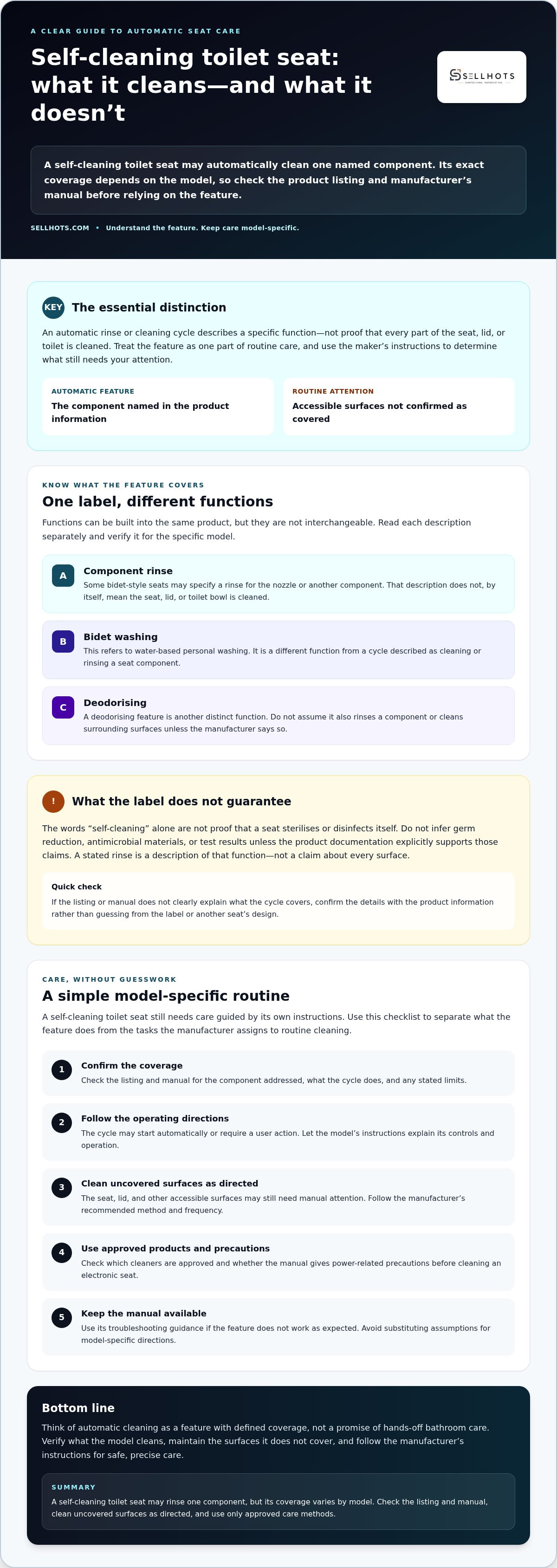
A self-cleaning toilet seat has a model-specific automatic cleaning feature, but the label alone doesn’t tell you what gets cleaned. The function may be designed for one component rather than the entire seat, lid, or toilet. Check the product listing and manufacturer’s manual for the exact description, including what the feature does and any limits the manufacturer identifies.
Automatic cleaning of a component is not the same as cleaning the whole seat or toilet. An automatic cycle can be a useful convenience without making every nearby surface self-cleaning. Before you rely on the feature, identify the component it covers and note what the product information says remains outside its scope.
Which Parts Might a Self-Cleaning Feature Address?
Some bidet-style seats may include a rinse for the nozzle or another specified component. A rinse cycle shouldn’t be assumed to clean the seat, lid, or toilet bowl. These are separate surfaces, and the model’s instructions should make clear which component the automatic function addresses.
Bidet functions are associated with water-based personal washing; the Bidet overview offers general background on the concept. That context doesn’t confirm a particular seat’s features. Functions vary by model, so verify each one in its listing and manual instead of inferring coverage from a product label or another seat’s design.
Self-Cleaning Versus Manual Cleaning
An automatic cycle doesn’t establish that every surface is clean. The seat and lid, along with other accessible surfaces around the toilet, may still need manual attention as part of routine care. The manufacturer’s directions should guide the cleaning method and frequency.
Use the maker’s wording as your guide. If the listing says a component is rinsed, treat that as a description of that function, not a promise that the whole seat or bowl is cleaned. If the instructions don’t clearly explain what the cycle covers, consult the manual or product information before relying on it. This simple check helps you separate the feature’s role from the rest of your cleaning routine.
How Does a Self-Cleaning Toilet Seat Feature Work?
A self-cleaning toilet seat feature works according to the specific model, so there isn’t one cycle or mechanism that applies to every seat. If the manufacturer describes an automatic rinse, the instructions should explain which component it addresses and how the cycle starts. Some controls may be automatic, while others may require a user action. Check the product details rather than assuming how yours operates.
Cleaning coverage depends on the exact model. A control labelled for a rinse or cleaning cycle describes only what the manufacturer confirms, not every function the seat may offer. Bidet washing, deodorising, and component cleaning are distinct functions, even when they’re built into the same product. When comparing seats, look for each function to be described separately.
Automatic Nozzle Rinsing and Bidet Functions
On a bidet-style seat, the nozzle delivers water for personal washing. A model may state that it rinses the nozzle, but that doesn’t mean the rinse cleans the seat, lid, or surrounding toilet. Read the manual for the cycle’s controls, operation, and stated limitations. If the instructions don’t explain a function clearly, consult the product information rather than guessing.
Bidet washing is separate from a nozzle-cleaning cycle: one describes personal washing, while the other may describe care for a component. The Healthline overview Are Bidets Sanitary? discusses bidets generally, but it can’t verify the cleaning coverage or care requirements of a particular seat.
What the Self-Cleaning Label Does Not Guarantee
The words “self-cleaning” shouldn’t be treated as proof that a seat sterilises or disinfects itself. Without explicit manufacturer information, don’t infer germ reduction, antimicrobial materials, or test results from the label. A stated rinse is simply a described function unless the product documentation says more.
Routine care still follows the manufacturer’s guidance for that model. Check which areas need manual cleaning, which products are approved, and whether the instructions include precautions before cleaning. The listing can help clarify what a feature is intended to do, while the manual provides model-specific operating and care directions.
If you’re comparing options, explore automatic toilet seats and check each listing for confirmed functions. Start by matching the stated feature to your expectations, then use the manufacturer’s instructions to care for the seat.
Does a Self-Cleaning Toilet Seat Replace Regular Cleaning?
A self-cleaning toilet seat shouldn’t be assumed to replace manual cleaning unless the manufacturer’s manual explicitly says so. An automatic feature may offer convenience for a particular component, but it doesn’t necessarily clean every surface people touch or address spills and visible soil elsewhere. Treat the automatic function and routine care as separate parts of looking after the seat.
An automatic rinse also isn’t proof that the entire seat has been cleaned or disinfected. Avoid drawing conclusions about hygiene, sterilisation, or germ reduction unless the manufacturer provides specific, supported information. The practical approach is to understand the feature’s stated coverage, then follow the care instructions for everything else.
Surfaces That May Still Need Manual Attention
Depending on the model, accessible areas may include the lid, seat surface, hinges, and controls. These parts aren’t necessarily covered by a nozzle rinse or another automatic cycle. Seats can differ in their components, materials, and access, so don’t assume a cleaning method suitable for one area is appropriate for another.
Use the manual to confirm how each part should be cleaned and whether any component needs special handling. Pay particular attention to instructions for areas around controls and hinges, where it may be tempting to reach or apply a product without checking first. Follow the manufacturer’s directions rather than treating the whole unit as one surface.
When to Check the Care Instructions
Consult the manual whenever visible soil or a spill needs attention. It can identify approved cleaning products, explain how to clean the affected part, and note model-specific precautions. If the instructions distinguish between the seat, lid, controls, or other components, follow those distinctions.
Care should reflect actual use and the maker’s recommendations. A spill may call for attention when it happens, while routine care should follow the guidance provided for that particular model. There isn’t one cleaning frequency that can be applied confidently to every seat without product-specific instructions.
In short, let the manual set the routine. The automatic feature may help with the function it was designed to perform, while manual care addresses surfaces and situations outside that scope. This keeps expectations clear and helps you care for the seat as intended.
How to Clean a Self-Cleaning Toilet Seat Safely
Before cleaning a self-cleaning toilet seat, consult the manufacturer’s manual for approved products and any power-related precautions. Check the specific seat manual before choosing a cleaner. Electronic components and surface materials can differ, so a method that suits one model may not be suitable for another.
A Gentle Routine for Everyday Surface Care
Use this routine as a starting point, adapting each step to the seat’s instructions:
- Read the manual. Confirm which cleaner and cloth are suitable, which areas need special care, and whether the instructions call for a power-related precaution before cleaning.
- Prepare the cleaning materials. Choose a soft cloth and only a product the manufacturer confirms is suitable. Follow any instructions about how to apply it.
- Wipe accessible surfaces gently. Clean only the areas covered by the manual, such as the seat or lid if specified. Don’t scrub, dismantle parts, or direct liquid toward controls or electrical components unless the instructions permit it.
- Finish as directed. Follow the manual’s guidance for drying and returning the seat to operation. Don’t restore power or use the seat until you’ve followed the maker’s instructions.
Take a measured approach. Gentle surface care is more reliable than improvising with a stronger product or reaching into components the manual doesn’t identify as user-cleanable.
Cleaning Products and Methods to Avoid
Don’t use bleach, abrasive cleaners, solvents, or spray products unless the manufacturer specifically approves them for your model. These products and application methods aren’t automatically suitable for every finish or electronic seat. Likewise, don’t soak the seat or direct water toward controls, connections, or other electronic parts unless the manual explicitly allows it.
If the instructions are unclear, pause rather than guess. Check the product information or contact the manufacturer for guidance on the cleaner, cleaning method, or power precautions. Keep those directions handy, especially if the seat has separate instructions for different surfaces.
Choosing an automatic toilet seat? Explore automatic toilet seats and check each product listing for confirmed features before reviewing its manual for care instructions.
How to Maintain a Self-Cleaning Toilet Seat Over Time
Keep the manual for your self-cleaning toilet seat somewhere easy to find. It’s the clearest reference for the feature’s intended operation, care requirements, and troubleshooting steps. If you no longer have a copy, check whether the manufacturer provides one for the specific model.
Use the manual to confirm that your routine still matches the maker’s directions. Product details can vary, so don’t rely on instructions for a different seat, even if its controls or cleaning feature appear similar.
What to Check if a Cleaning Feature Does Not Work
If a stated cycle doesn’t operate as described, start with the troubleshooting instructions for that model. Check only the controls and conditions mentioned there, and follow the manufacturer’s steps in order. Don’t open the seat, attempt a repair, or assume you know the cause based on the symptom alone.
If the manual’s basic troubleshooting guidance doesn’t help, use the product’s stated support route for further direction. This keeps the next step grounded in model-specific advice rather than trial and error.
Choose by Documented Features, Not the Label Alone
Before choosing a seat, read the listing closely. Look for the component it specifically says is cleaned and compare that description with your expectations. Then review the controls and care information so you understand how the feature is used and what routine maintenance the manufacturer recommends.
A broad label may not explain a feature’s coverage. Clear, specific wording is more useful because it helps distinguish a confirmed cleaning function from other functions and identifies care details to consider.
SellHots offers automatic toilet seats to explore, but the available product information doesn’t confirm that any specific seat has a self-cleaning feature. Check each listing for documented functions, then consult the manufacturer’s manual for confirmed operation and care instructions. Reviewing both helps you choose a seat that fits your expectations and maintain it with confidence.
Care with Confidence, Choose with Clarity
A self-cleaning toilet seat is easier to care for when you know exactly what its automatic feature covers. Check the product listing and manual for the component it cleans, approved cleaning methods, and model-specific operating guidance. An automatic cycle can add convenience, but it shouldn’t be treated as a replacement for routine care unless the manufacturer says so.
For everyday upkeep, follow the manual rather than guessing about cleaners, liquids, or electronic parts. If a feature doesn’t work as described, consult the model’s troubleshooting instructions before taking another step. These habits help protect the seat and keep expectations grounded in confirmed information.
SellHots offers automatic toilet seats as part of its bathroom product range. Explore the options and review each listing to confirm the features that matter to you, then consult the manufacturer’s manual for care details. Explore SellHots automatic toilet seats and choose with the feature information in hand.
Frequently Asked Questions
Does a self-cleaning toilet seat clean the whole toilet?
No, a self-cleaning feature doesn’t necessarily clean the whole toilet. Coverage depends on the specific model and may apply only to a named component. It doesn’t establish that the seat, lid, bowl, or nearby surfaces are clean. Check the product listing and manual for the feature’s stated scope, then care for other surfaces as the manufacturer directs.
Do I still need to clean a self-cleaning toilet seat?
Usually, you should still clean a self-cleaning toilet seat as directed by its manufacturer. An automatic cycle may cover only one specified component, leaving accessible surfaces to be cared for separately. Follow the exact model’s instructions for approved cleaners and precautions. Confirm the feature’s coverage in the manual and follow the recommended care steps.
How often should you clean a self-cleaning toilet seat?
There isn’t a universal cleaning schedule for every seat or household. Follow the product manual and respond to visible soil or spills according to its care directions. An automatic function may not cover every surface, so check which parts need manual attention. If the manual doesn’t provide a routine, contact the manufacturer for model-specific advice rather than guessing about frequency or suitable products.
Can you use bleach on a self-cleaning toilet seat?
Use bleach only if the manufacturer specifically approves it for that model. A cleaner suitable for one surface may be unsuitable for another, especially near electronic components. Check the manual for approved products and methods before applying anything. If its instructions are unclear, contact the manufacturer rather than testing bleach on the seat.
What does the self-cleaning function on a toilet seat clean?
It depends on the specific product. A listing may describe an automatic rinse or cleaning cycle for one component, such as a bidet nozzle, but don’t assume every seat has that function. The feature may not clean the lid, seat surface, toilet bowl, or bathroom. Confirm the stated coverage and limits in the model’s product information and manual before relying on it for your cleaning routine.
Can water damage an electronic self-cleaning toilet seat?
Water could damage an electronic seat if it reaches areas the manufacturer says to protect. Follow the model manual before applying water or cleaner, especially around controls and electronic components. Don’t soak the seat or spray protected areas, and don’t assume another model has the same safeguards. If the cleaning instructions aren’t clear, contact the manufacturer before proceeding.
What should you do if a self-cleaning toilet seat stops working?
Start with the manual’s troubleshooting instructions for that exact model. Follow only the basic checks the manufacturer recommends, and don’t dismantle the seat or attempt repairs without guidance. If the feature still doesn’t work as described, contact the manufacturer or the support contact provided with the product listing. Avoid guessing at the cause from the feature label or symptom alone.